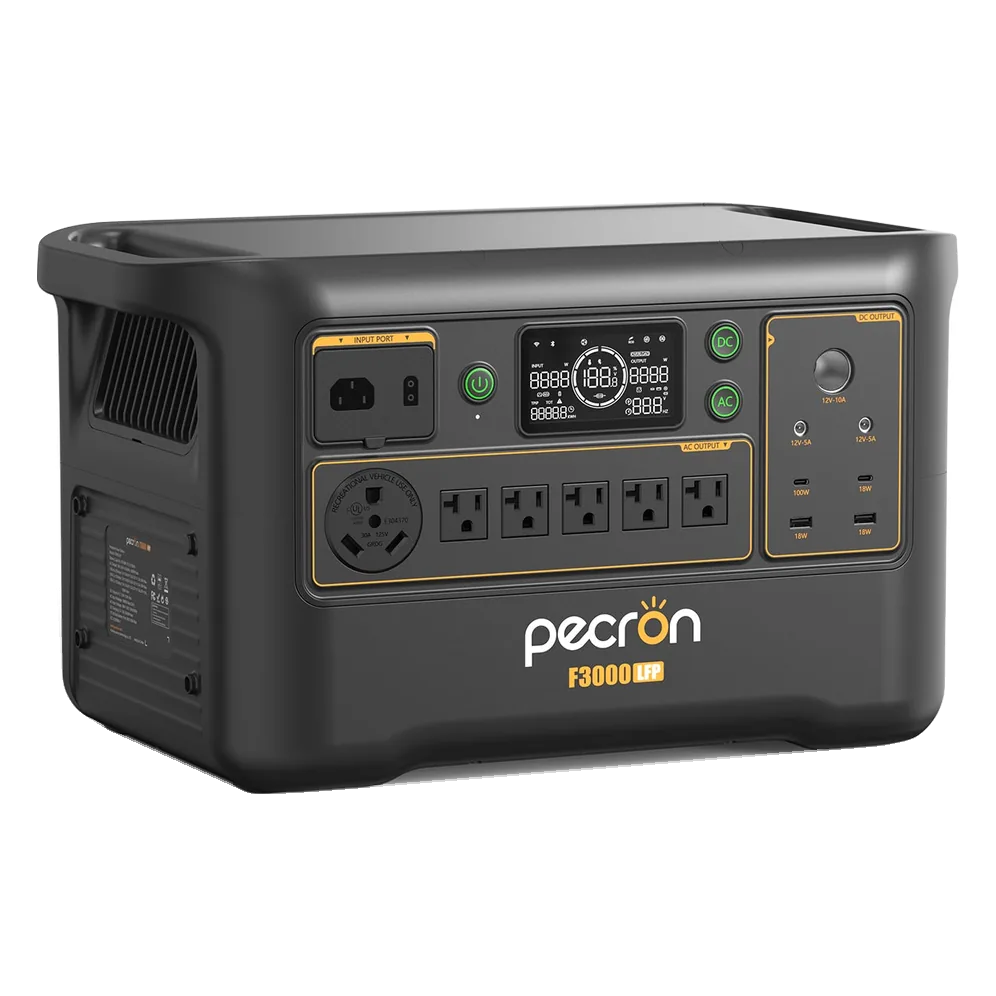
Pecron F3000LFP Portable Power Station

SVT Score, Upper

Versus
6.6
SVT SCORESRead review

3,072 Wh LiFePO4 station at 63.3 lb with a 3,600 W inverter and a TT-30R outlet, 120 V only; TheSolarLab drew 83 percent of rated capacity at a full 3,600 W load.

$899

We may earn a commission if you buy through this link. It never affects our scores. How this works

SKU: F3000LFP Category: Brand:

Usability

6.6 out of 10

It stores 3,072 Wh, near the top of the large tier, so it scores 7 on capacity; TheSolarLab drew 83 percent of it at a full 3,600 W load.

Its inverter is rated 3,600 W continuous and 4,500 W surge at 120 V only, so it scores 10 on power output.

Pecron states a full wall charge in 2 hours at 1,800 W and solar input tops out at 1,600 W, so it scores 7 on recharging.

Pecron rates the cells for 3,500 cycles to 80 percent capacity, so it scores 6 on battery life.

It switches to battery in 8 to 20 ms and takes two expansion batteries to a rated 10,752 Wh, but Pecron sells no transfer switch or 240 V box for it, so it scores 6 on backup readiness.

Pecron publishes no safety certificate for it and no certifier directory lists it by model, so it scores 2 on verification.
Better on verificationAnker SOLIX F3000SGS lists it to UL 2743 and. $1,399.99Scores 6.0

Pecron's policy gives it 5 years when registered within 30 days, so it scores 8 on warranty and support.

Warranty and returns

Registration adds three years to the E1500LFP, F1000LFP and F3000LFP and one year to other stations, with 30-day returns on pecron.com orders.

$899.00 at pecron.com.

Full 3,600 W for under $900, 120 V only

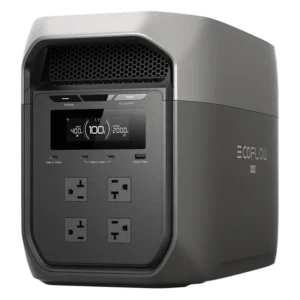
The F3000LFP is Pecron's 3,072 Wh LiFePO4 station, a 63.3 lb unit with five 120 V outlets, a TT-30R 30 A outlet and every port on its front panel.

Verdict

It suits a buyer who wants 3 kWh and a 3,600 W inverter at 120 V for under $900 and has no 240 V load to run.

Strengths

  • 3,600 W continuouswith 4,500 W held about 10 seconds by TheSolarLab
  • TT-30R 30 A outlet
  • 1,600 W solar input at 25 to 120 V
  • Full wall charge in about 2 hours at 1,800 W
  • Expands to a rated 10,752 Wh with two EP3800-48V batteries
  • 5 years of warranty with free registration

Drawbacks

  • 120 V onlywith no 240 V option
  • 37 W idle draw in TheSolarLab's test
  • UPS mode covers loads under 1,800 W only
  • Expansion needs a separately sold XT120 cascade cable
  • No IP rating and no built-in light
  • One solar input with one MPPT

Social score

7.3 out of 10
Reddit6.0 out of 10
Liked
  • Ran all 120 V house circuits since November, per one owner
  • Ran a garage with one expansion battery for almost a year, per one owner
Complaints
  • Fell from 70 to 1 percent in storage and charged at 60 W, per one owner
  • Tesla charger refused it for outlet grounding, per one owner
  • App would not connect until a 2.4 GHz network was set up, per one owner

Owner posts on the F3000LFP in r/SolarDIY and r/PortableBatteryPacks run from February to June 2026. One owner has run all of his 120 V house circuits from it since November and cleared an early app connection fault by setting up a 2.4 GHz network (r/SolarDIY). Another has run a garage from it with one expansion battery for almost a year without issues (r/SolarDIY). A unit stored over winter fell from 70 to 1 percent in under 12 hours with nothing plugged in, then charged at 60 W (r/PortableBatteryPacks, March 2026). A Tesla mobile connector refused to charge from it, citing inadequate outlet grounding (r/SolarDIY, February 2026).

Google8.0 out of 10
Liked
  • Held 4,500 W for about 10 seconds, per one reviewer
  • Full wall charge in just over two hours, per one reviewer
  • Reached 1,600 W of solar input, per one reviewer
Complaints
  • 37 W idle draw, per one reviewer
  • AC outlets too close together, per one reviewer
  • No built-in light, per one reviewer

TheSolarLab, which earns affiliate commission on its links, ran a full 3,600 W load without a trip, held 4,500 W for about 10 seconds, drew 83 percent of rated capacity at 3,600 W, recharged it from the wall in just over two hours and pulled 1,600 W of solar, and faulted a 37 W idle draw, AC outlets set too close for bulky plugs and the lack of a light (updated October 2026).

YouTube7.0 out of 10
Liked
  • 93 percent usable on AC at 860 W, per one channel
  • 1,753 W AC charging, per one channel
  • 180 W from the DC output, per one channel
Complaints
  • Phone app, per one channel

Lithium Solar, which uses affiliate links and a Pecron discount code, drew 2,863 Wh at an 860 W load, 93 percent of rated, saw 1,753 W of AC charging, opened the case and disliked the phone app (January 2026, about 34,000 views). Jasonoid, whose video is marked as paid promotion and carries a Pecron discount code, drew 180 W from the DC output and was surprised by its test results (August 2025, about 56,000 views).

Amazon8.0 out of 10
Liked
  • Reliability, tagged positive in 43 of 51 mentions
  • Value for money, tagged positive in 29 of 31 mentions
  • Power, tagged positive in 11 of 13 mentions
Complaints
  • Charging performance, tagged negative in 11 of 27 mentions
  • Weight, tagged negative in 9 of 12 mentions
  • Noise, tagged negative in 6 of 18 mentions

The station listing (B0F6YCRKTJ), sold by PECRON Direct, reads 4.5 from 154 ratings, 76 percent five-star, 14 percent four-star and 5 percent one-star. Amazon's review tags are positive on reliability (43 of 51 mentions) and value (29 of 31) and split on charging performance (11 of 27 negative) and weight (9 of 12 negative). It scores one point lower because Walmart flags most reviews on Pecron's own listings as incentivized.

User reviewsNot scored

The retailer pool is blank: Walmart is the only US retailer with Pecron files, sold there by Pecron itself, and with its incentivized and pecron.com reviews set aside none holds ten native reviews.

Trustpilot

Trustpilot rates pecron.com 3.6 from 53 reviews, 56 percent five-star and 26 percent one-star, on a claimed profile that has not invited reviews recently.

Track record

The BBB rates Pecron LLC F without accreditation, with six complaints in three years, and no CPSC recall names a Pecron product.

Not countedExcluded

Not counted in any pool: pecron.com's own review widget and media quotes, Pecron's own YouTube channels, or its Facebook owners group.

Brand-level

3.6 on Trustpilot, an F from the BBB

Specs

  • Capacity3,000-3,999 Wh
  • AC Output3,000-3,999 W
  • Output Voltage120 V only
  • Battery ChemistryLiFePO4
  • Rated Cycles3,000-3,999 cycles
  • Safety ListingNone verifiable
  • Solar Input1,000-1,999 W
  • Backup Switchover11-20 ms
  • Warranty5 Years
  • Expandable To10-19.9 kWh
  • Weight63.3 lb

At a glance

  • Five 120 V 20 A outlets
  • TT-30R 30 A RV outlet
  • Wi-Fi and Bluetooth app

Shenzhen Pecron Technology Co., Ltd., founded in 2012, makes Pecron stations, and Pecron LLC of City of Industry, California, sells them in the US.

It sells direct from pecron.com, through its own PECRON Energy store on Amazon US, and as a marketplace seller on Walmart.com.

The Pecron F3000LFP is a 3,072 Wh LiFePO4 station rated 3,600 W continuous and 4,500 W surge for 5 seconds from five 120 V 20 A outlets and a TT-30R 30 A outlet, with a 100 W USB-C port, an 18 W USB-C port, two 18 W USB-A ports, a 12 V 10 A car outlet and two 12 V 5 A DC5525 ports. Pecron states a full wall charge in 2 hours at 1,800 W, or 1.5 hours at 2,800 W with AC and solar together, and it takes up to 1,600 W of solar through one XT60 input at 25 to 120 V. Pecron rates the cells for 3,500 cycles to 80 percent capacity and states an automatic switchover of 8 to 20 ms for loads under 1,800 W, and two EP3800-48V batteries take it to a rated 10,752 Wh through a separately sold XT120 cascade cable. Its output is 120 V only; Pecron's 240 V Connect Box is made for the E3600LFP and E3800LFP, not this unit. It weighs 63.3 lb, measures 19.3 x 11.6 x 11.1 in and carries no IP rating.
Stuff VS Things
Logo
Compare items
  • Total (0)
Versus
2
Shopping cart