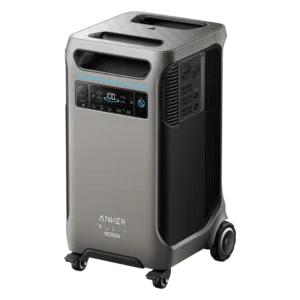
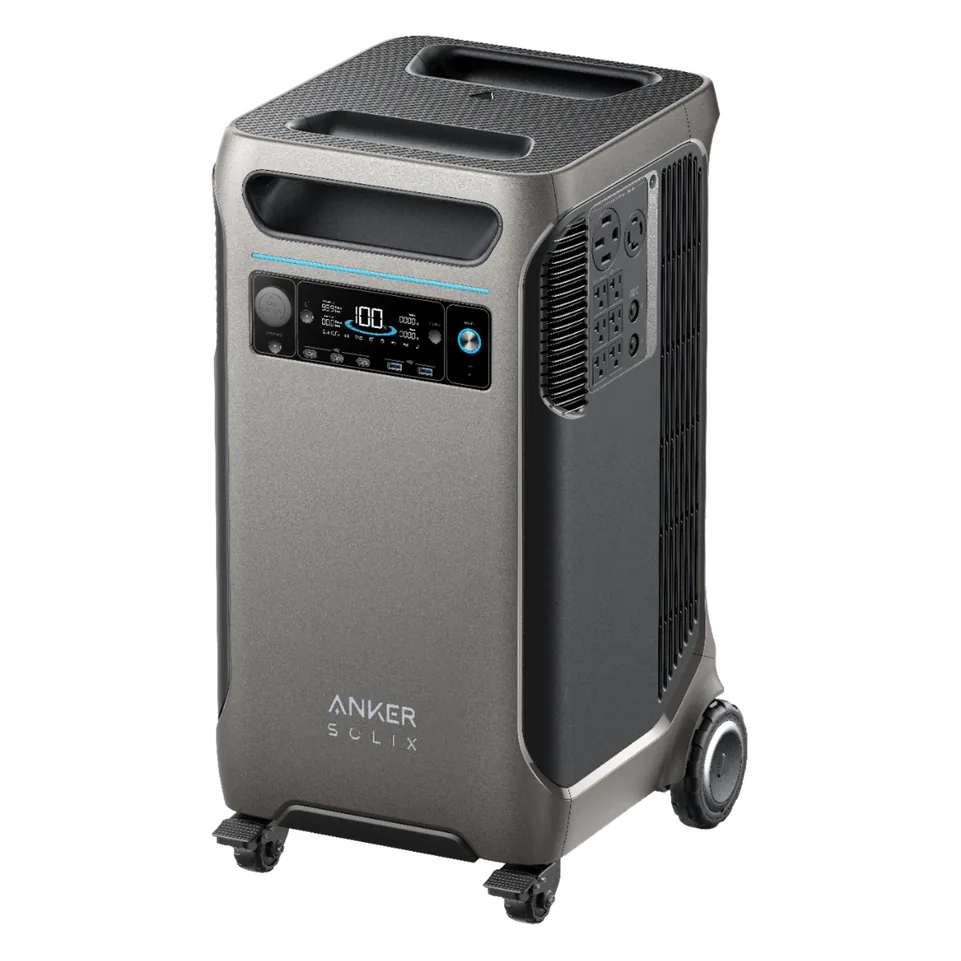
Anker SOLIX F3800 Portable Power Station

SVT Score, Mid

Versus
6.6
SVT SCORESRead review

3,840 Wh home station with 120/240 V from one unit; StorageReview drew 2,980 Wh, 77.6 percent of rated.

$1,980

We may earn a commission if you buy through this link. It never affects our scores. How this works

SKU: A1790111 Category: Brand:

Usability

6.6 out of 10

It stores 3,840 Wh, the typical size on the home tier's scale, so it scores 5 on capacity; StorageReview drew 2,980 Wh of it, 77.6 percent of rated.
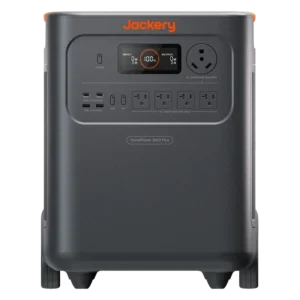
Better on capacityJackery Explorer 5000 PlusStores 5,040 Wh on its own. $3,499Scores 8.0

Its inverter supplies 6,000 W continuous at 120/240 V from one unit, so it scores 8 on power output.

TheSolarLab charged it from a 120 V outlet in 2 hours 35 minutes and two inputs take 2,400 W of solar, so it scores 7 on recharging.

Anker rates the cells for 3,000 cycles to at least 80 percent capacity, so it scores 6 on battery life.

It switches three 120 V outlets to battery within 20 ms, takes six BP3800 batteries to 26,880 Wh and works with Anker's Home Power Panel and a 10-circuit 120/240 V transfer switch, so it scores 7 on backup readiness.

SGS lists it to UL 2743 and its battery to UL 1973 by model, but no UL 9540 system listing names it, so it scores 6 on verification.

Anker's policy gives it 5 years, so it scores 8 on warranty and support.

Warranty and returns

Its warranty runs 5 years on every current station from purchase, with returns within 30 days on ankersolix.com orders.

$1,979.99 at ankersolix.com.

240 V from one box, not while wall charging

The F3800 is Anker's 3.84 kWh LiFePO4 home backup station with 120/240 V split-phase output from one unit, a 132.3 lb box on wheels.

Verdict

It suits a buyer who wants 240 V circuits through a transfer switch or panel from one unit and accepts no 240 V output while it charges from a 120 V outlet.

What we like

  • 120/240 V split-phase from one unit
  • 6,000 W continuous and 9,000 W surge
  • Expands to 26,880 Wh per unit
  • 13 ms UPS cutover in StorageReview's test
  • UL 2743 listing by model in SGS's directory

What holds it back

  • No 240 V output while charging from 120 V
  • Solar inputs limited to 60 V
  • StorageReview drew 77.6 percent of rated capacity
  • About 80 W idle draw in TheSolarLab's test
  • 132.3 lb

Social score

6.8 out of 10
Reddit5.0 out of 10
Complaints
  • Round-trip efficiency of 60 to 68 percent, per three owners
  • Standby use of about 1 kWh a day or more, per two owners

An r/SolarDIY thread from August 2024 gathers four F3800 owners running it for home backup or bill savings, and all four report energy losses. The owner of two units on a Home Power Panel measured about 68 percent from solar input to output and suspected about 2 kWh a day of overhead. A second owner saw close to 60 percent round trip charging from the grid, a third measured 90 percent out and 78 percent in for a 32 percent round-trip loss, and a fourth saw 0.8 to 1.2 kWh a day of standby use across two units.

Google8.0 out of 10
Liked
  • Wide range of outlets including 240 V, per two reviewers
  • 13 ms UPS cutover, per one reviewer
  • Ran a compressor and car lift, per one reviewer
Complaints
  • Heavy, per two reviewers
  • Solar input hard to max at 60 V, per one reviewer
  • About 80 W idle draw, per one reviewer

CNET, which earns commission on sales, scored it 9.0, and its lab manager called it his favorite station for its output options, capacity and home integration, and faulted its price and weight (August 2024). StorageReview drew 2,980 Wh, 77.6 percent of rated, needed 4,930 Wh to refill it and measured UPS cutover at 13 ms (June 2024). TheSolarLab, which earns affiliate commission, measured about 84 percent at a 5,100 W load and a full 120 V charge in 2 hours 35 minutes, ran a 3,000 W compressor and a car lift, and found 2,400 W of solar hard to reach through the 60 V inputs (March 2025). Its F3000 review put the F3800's idle draw at about 80 W.

YouTube7.0 out of 10
Liked
  • Automatic home backup on the Home Power Panel, per one channel
  • Ran house circuits through a transfer switch, per one channel
Complaints
  • No wall charging while 240 V runs, per one channel
  • No charge-limit setting in the app, per one channel

Backyard Maine, which earns commission on tagged products and links an Anker discount, ran it for three months on the Home Power Panel as automatic whole-home backup and added an expansion battery (November 2024, about 180,000 views). Dustin Dunnill, posting Amazon affiliate links, wired it to a transfer switch, ran it near its limit and found 120 V charging stops while the 240 V output is in use, and faulted the app for lacking charge limits (August 2024, about 21,700 views). Cleanerwatt, in a video sponsored by Anker, estimated a full wall charge at 2.7 to 3 hours (January 2024, about 10,900 views).

Amazon9.0 out of 10
Liked
  • Performance, tagged positive in 56 mentions
  • Reliability, tagged positive in 41 mentions
  • Value for money, tagged positive in 20 mentions
Complaints
  • Charging speed, tagged negative in 12 mentions
  • Value for money, tagged negative in 11 mentions
  • Weight, tagged negative in 9 mentions

The station-alone listing (B0C5C9HMQ2), shipped and sold by AnkerDirect, reads 4.5 from 323 ratings, 75 percent five-star and 7 percent one-star, and the same page also sells Home Backup Kit, Home Power Panel and BP3800 bundles. Amazon's review tags are positive on performance (56 of 63 mentions), reliability (41 of 51) and outage backup (12 of 13), mixed on charging speed (12 negative of 27) and value (11 negative of 31), and negative on weight (9 of 11).

User reviews5.0 out of 10
Liked
  • Ran home circuits through a panel or switch, per four reviewers
  • Well built, per one reviewer
Complaints
  • Solar or DC inputs failed, per two reviewers
  • No wall charging while 240 V output runs, per two reviewers
  • Shut down at about 1,800 W of UPS load, per one reviewer

Home Depot's file holds 52 reviews averaging 4.4 with a 50 percent recommend rate, and 28 of them carry Anker's syndication badge and one the Reviewer Program badge, so the average is lifted by entries Anker collected. The 23 native reviews from 2024 to 2026 split between owners running a well pump, a fridge or panel circuits through a transfer switch and owners reporting failed solar or DC inputs, a display failing after a year and no wall charging while the 240 V output runs. One business owner found it shut down at about 1,800 W of UPS load. Best Buy's listing has no reviews.

Trustpilot

Trustpilot rates Anker SOLIX US 4.1 from 654 reviews, 71 percent five-star and 17 percent one-star, on a claimed profile that invites reviews.

Track record
  • The BBB rates Anker Innovations F without accreditation at its Ontario, California address, with 62 complaints filed in the last three years.
  • CPSC recall records from 2022 through 2026 show zero recalls of an Anker SOLIX or PowerHouse power station sold in the United States.
  • A California class action, Coffey v. Fantasia Trading LLC, filed in April 2026, alleges Anker SOLIX discounts run from reference prices it rarely charges.
Not countedExcluded

Not counted in any pool: ankersolix.com's own review widget, entries syndicated from it, the brand-run r/AnkerSOLIXCommunity, or incentivised reviews.

Brand-level

4.1 on Trustpilot, an F from the BBB

What you’re getting

  • Capacity3,000-3,999 Wh
  • AC Output6,000 W or more
  • Output Voltage120/240 V split-phase
  • Battery ChemistryLiFePO4
  • Rated Cycles3,000-3,999 cycles
  • Safety ListingUL 2743 listed
  • Solar Input2,000-3,999 W
  • Backup Switchover11-20 ms
  • Warranty5 Years
  • Expandable To20 kWh or more
  • Weight132.3 lb

At a glance

  • NEMA 14-50R and L14-30R
  • Six NEMA 5-20R outlets
  • Wi-Fi and Bluetooth app

Anker SOLIX is the energy brand of Anker Innovations Technology Co., Ltd., a Changsha company founded by Steven Yang in 2011.

It sells direct from ankersolix.com and through Amazon US, Home Depot, Lowe's, Best Buy, Walmart and Sam's Club.

The Anker SOLIX F3800 is a 3,840 Wh LiFePO4 station rated 6,000 W continuous and 9,000 W surge at 120/240 V split-phase from one unit, with six 20 A outlets, a NEMA 14-50 outlet and an L14-30 outlet, three 100 W USB-C ports, two USB-A ports and a 12 V car outlet. It takes 1,800 W from a 120 V wall outlet and up to 2,400 W of solar through two 11 to 60 V XT60 inputs. Anker rates the cells for 3,000 cycles to at least 80 percent capacity and states a 20 ms UPS switchover on three of its 120 V outlets. It takes six BP3800 batteries for 26,880 Wh per unit, and two units reach 12,000 W and 53,760 Wh through Anker's Double Power Hub. It weighs 132.3 lb and measures 27.6 x 15.3 x 15.6 in with its wheels.
Stuff VS Things
Logo
Compare items
  • Total (0)
Versus
2
Shopping cart