
Product comparison · Reverse Osmosis
iSpring RCC7D vs Express Water RODI10
The iSpring RCC7D scores 5.6 and ranks 56th of 69 in Reverse Osmosis; the Express Water RODI10 scores 6.1 and ranks 33rd of 69 in Reverse Osmosis. The RCC7D leads on ease of installation, the RODI10 on value.
 All 24 iSpring products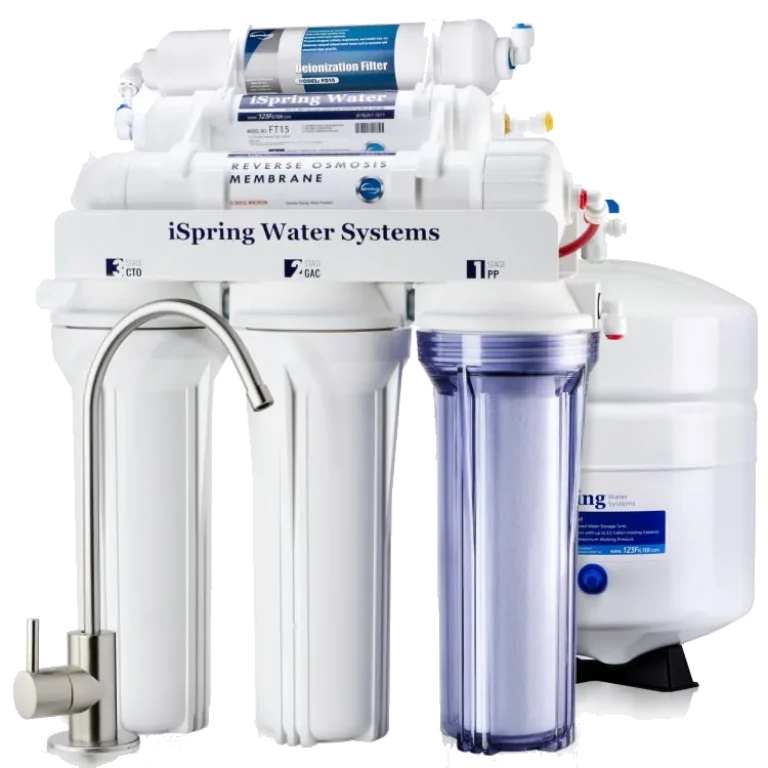
iSpring RCC7D
$303 · 56th of 69 in Reverse Osmosis
- Ease of Installation — 8 against 5
5.6

6.1
All 24 Express Water products 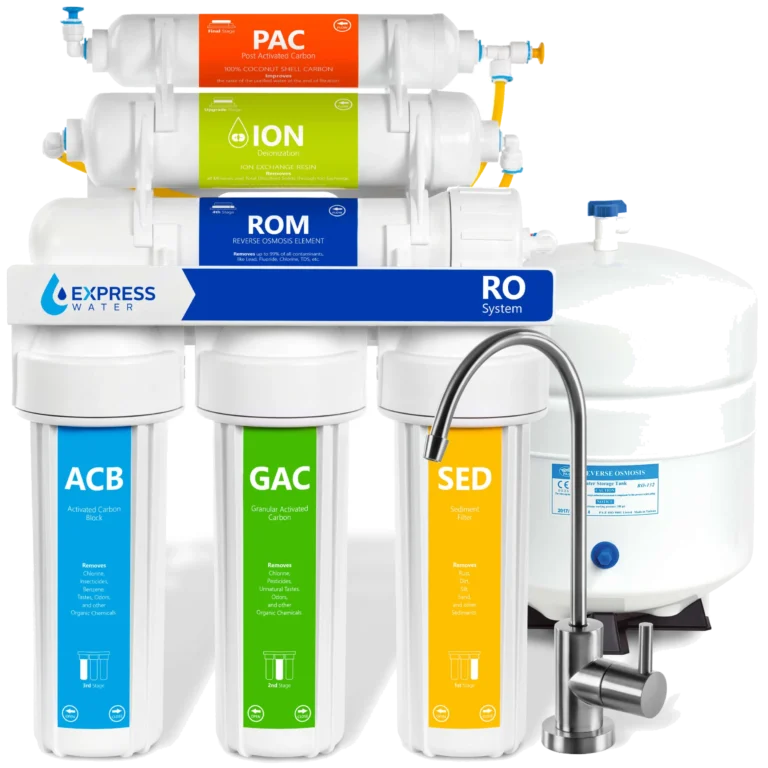
Express Water RODI10
$231 · 33rd of 69 in Reverse Osmosis
- Value — 7 against 5
Across everything we scored, Express Water RODI10 sits 0.52 ahead — led by value.
Verdict
RODI10 ahead · +0.52 (6.1 vs 5.6)Pick the iSpring RCC7D when
Ease of installation matters8vs5
Build quality matters7vs6
Pick the Express Water RODI10 when
Value matters7vs5
Price matters$231vs$303
Where the iSpring RCC7D and Express Water RODI10 differ
Scores on a 0–10 scale. Each row is one criterion, biggest difference first.
Ease of Installation
+3 iSpringBuild Quality
+1 iSpringContaminant Reduction
tiedCertification Coverage
tiedFlow Rate
tiedFilter Life
tiedWarranty & Support
tiedWhat iSpring RCC7D and Express Water RODI10 owners report
Independent sources, scored for each model. RCC7D on 5 of five, RODI10 on 5.
The iSpring RCC7D reading covers its product line; the Express Water RODI10 reading covers its product line.
What they say
iSpring RCC7D
- Reef-keeping and RO/DI discussion centres on how fast the DI resin exhausts and on the need for a TDS meter to track it rather than on this model by name, and a thread in r/espresso describes using an iSpring five-stage system specifically for zero-TDS water.
- The RCC7 chassis underneath is well covered in r/WaterTreatment, with an owner lab report showing arsenic to non-detect below 2 ppb set against a recurring leak cluster at faucet handles and housing joints after cartridge changes.
Express Water RODI10
- r/WaterTreatment recommends the Express Water tank platform for taste and value while calling the install more involved than rivals and the tank bulky, with weeping housing O-rings the recurring mechanical complaint.
- No thread addressing the deionisation variant specifically was found; reef and homebrewing discussions of RO/DI do not name this model, though one r/Homebrewing thread reaches for the platform's RO5DX and is lukewarm on taste.
The iSpring RCC7D reading covers its product line; the Express Water RODI10 reading covers its product line.
What they say
iSpring RCC7D
- Independent coverage of the RCC7 chassis disagrees with itself and the disagreement is the finding.
- TechGearLab lab-tested the alkaline build at 91 out of 100 and ranked it third of thirteen, measuring 100 percent removal of lead, arsenic, uranium and lithium.
- WaterFilterGuru scored the base chassis 6.64 overall with contaminant reduction at 5.25, measured production at roughly 35 gallons a day against a 75 GPD rating, and recorded vanadium and arsenic appearing in the filtered water.
- RO-System.org has withdrawn its recommendation of the base model outright, on the grounds that similar money now buys a more efficient system with a better warranty.
- This model is not separately covered by any of the three.
Express Water RODI10
- WaterFilterGuru bench-tested the platform's RO5DX with Tap Score lab analysis at 8.13 overall, rating component quality outstanding and setup weak.
- TapWaterData's audit records no certifier listing for the deionisation configuration, so the near-zero TDS claim has no third-party check.
YouTube
tiedThe iSpring RCC7D reading covers its product line; the Express Water RODI10 reading covers its product line.
What they say
iSpring RCC7D
- No channel has tested a deionization build of this chassis, and the reef and laboratory audiences that use zero-TDS water discuss resin exhaustion and TDS metering rather than reviewing hardware.
- BOS Water's laboratory testing of the alkaline build — the channel earns a commission on the system it tested — covers the RO stages underneath this system and found strong reduction alongside boron rising from 0.005 to 0.17 ppm, vanadium at 0.02 ppm and trace aluminium, none of which was in the feed water.
- A DI stage after the membrane is specifically designed to strip what that testing found, which makes the finding less relevant here than on a drinking build.
Express Water RODI10
- An independent lab tester excluded the platform's RO5DX from a best-of list over its three-flush break-in, which applies to this chassis.
- No hands-on video of the deionisation variant was found across five query angles.
Amazon
+2 Express WaterThe iSpring RCC7D reading covers the whole brand; the Express Water RODI10 reading covers its product line.
What they say
iSpring RCC7D
- No Amazon listing for the RCC7D surfaced under any search, which on a marketplace where every other tanked iSpring is listed is a distribution fact rather than a thin result; the model sells through iSpring and the big-box retailers instead.
- Falling back: Amazon's brand panel puts 91 percent of iSpring ratings at four stars or better over 100,000-plus orders in the trailing three months, collected across a catalogue that is mostly replacement cartridges and mainstream drinking systems rather than laboratory-grade deionization.
Express Water RODI10
- The deluxe-faucet sibling ASIN B010RD13NM reads 4.5 from 285 ratings for the same six-stage deionisation system; faucet finish is the only difference from this SKU.
- The figure does not repeat on other Express Water listings, so it is a genuine pool at the line rather than a brand aggregate - Amazon publishes no star panel for this brand.
Owner reviews
+3 Express WaterThe iSpring RCC7D reading covers the whole brand; the Express Water RODI10 reading covers its product line.
What they say
iSpring RCC7D
- Home Depot and Tractor Supply both carry the RCC7D, framed around aquariums, laboratories and spot-free rinsing rather than drinking water, and neither publishes a readable product-level rating for it.
- Falling back to the brand's Home Depot record: the figures that return are 98 percent recommend on the pumped RCC7 and 93 percent on the pooled tankless file, both from review files that carry iSpring's own attribution line against individual reviews and are therefore mixed.
Express Water RODI10
- Home Depot stocks the deionisation configuration as internet #307470687 with its own review file, in which an owner reports municipal water at 250 ppm falling into the teens and then below 5 ppm after three tank cycles.
iSpring RCC7D vs Express Water RODI10: pros and cons
What each one does well, and where it falls short.
Pros 7
Produces near-zero TDS water, purer than distilled, for reef tanks, labs and microelectronics
Six stages including a dedicated DI resin filter after the RO membrane
Up to 1:2 pure-to-waste, better than the 1:3 of the standard RCC7
Storage tank is swappable for 5.5, 11, 20 or 40-gallon sizes for higher-volume use
Wide 750 ppm maximum feed TDS tolerance
Standard 10x2.5 inch cartridge format is easy to source
Uses the same well-documented RCC7 chassis with published install and service videos
Cons 7
iSpring states the water is not recommended for drinking, which big-box listings rarely make clear
Highest consumable cost in the tanked line at roughly $94 a year for the F9D one-year DI set
DI resin depletes faster than carbon and needs monitoring with a TDS meter
iSpring does not publish a complete-system NSF/ANSI 58 certification for the RCC7D, only component compliance
Costs $72 more than the standard RCC7 for a stage most households will not use
Warranty is 1 year and requires product registration to activate
Wider 8-inch footprint than the RCC7, so under-sink clearance needs checking
Pros 5
Mixed-bed DI stage drives TDS far below what a membrane alone achieves
Four upstream stages protect the resin and lower cost per gallon versus standalone DI
Genuinely useful for reef tanks, espresso machines and lab rinse water
Point-of-use softening without adding sodium
Shares housings and cartridges with the rest of the Express Water range
Cons 6
DI water is flat to drink and mildly aggressive to plumbing metals
Resin life is entirely dependent on incoming TDS and no capacity figure is published
No NSF listing of any kind
One-year warranty
50-100 GPD production with a one to three gallon drain ratio
Extra consumable cost on top of an already six-cartridge system
iSpring RCC7D vs Express Water RODI10: the numbers
Price, scores and rank, then only the specs that differ. Green marks the side with more.
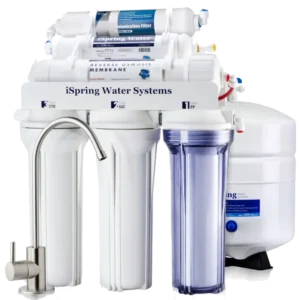
5.6
56th of 69 in Reverse Osmosis
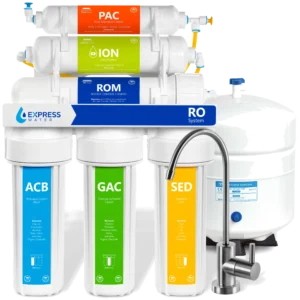
6.1
33rd of 69 in Reverse Osmosis
Removes
Both Arsenic, Calcium, Chlorine, Fluoride, TDS, Lead
iSpring RCC7D
+ PFAS, Sodium, Asbestos
Express Water RODI10More
+ Heavy metals, Magnesium, Nitrate, Hardness
SpeciSpring RCC7DExpress Water RODI10
HousingBPA-Free PlasticNot listed
Dimensions18.00 x 8.00 x 15.00 in17 x 15 x 5 in
Weight26 lb12.8 lbs
Made inTaiwanNot listed
Same on both
- Filtration Carbon Block, Granular Activated Carbon, Reverse Osmosis, Sediment, Specialty Resin
- Certifications Not certified
- Flow rate Under 100 GPD
- Filter life 6-12 months
- Warranty 1 Year
- Connection Point of use fitting
We earn a commission if you buy through these links. It never changes a score.
Not sold on either one?
The top-scored and the cheapest other pick from each brand.
More from iSpring 23 scored in Reverse Osmosis
What’s different
- Filtration: adds Alkaline Remineralization
- Certifications: adds NSF/ANSI 58
Pick it ifCertification coverage matters5vs2NSF/ANSI 58 only on the RCC7AK
What’s different
- Filtration: no Specialty Resin
- Certifications: adds NSF/ANSI 58
Pick it ifCertification coverage matters5vs2NSF/ANSI 58 only on the RCC7
More from Express Water 11 scored in Reverse Osmosis
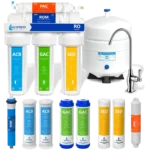
What’s different
- Filtration: no Specialty Resin
- Certifications: adds NSF/ANSI 58, NSF/ANSI 372
Pick it ifCertification coverage matters7vs2NSF/ANSI 58 only on the RO5DX
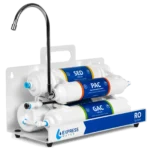
What’s different
- Filtration: no Specialty Resin
- Removes: adds Sediment
Pick it ifEase of installation matters9vs5
iSpring RCC7D vs Express Water RODI10: common questions
Is the iSpring RCC7D better than the Express Water RODI10?
On our scores, the Express Water RODI10 is ahead, 6.1 against 5.6. The Express Water RODI10 leads on value (7 against 5). The iSpring RCC7D leads on ease of installation (8 against 5) and build quality (7 against 6).
Which is cheaper, the iSpring RCC7D or the Express Water RODI10?
The Express Water RODI10, at $231 against $303: $72 less.
Which removes more contaminants, the iSpring RCC7D or the Express Water RODI10?
The iSpring RCC7D lists 9 and the Express Water RODI10 lists 10, with 6 on both lists. Only the Express Water RODI10 lists Heavy metals, Magnesium, Nitrate and Hardness.
What do owners say about the iSpring RCC7D and the Express Water RODI10?
Across 5 independent sources scored for both, the iSpring RCC7D is ahead on Reddit; the Express Water RODI10 is ahead on Google, Amazon and Owner reviews; YouTube is level.
More reverse osmosis comparisons
More head-to-heads with these two, plus the full brand comparison.
Scores calculated 16 September 2026 · Products excluded where fewer than two independent sources cover them · How we score