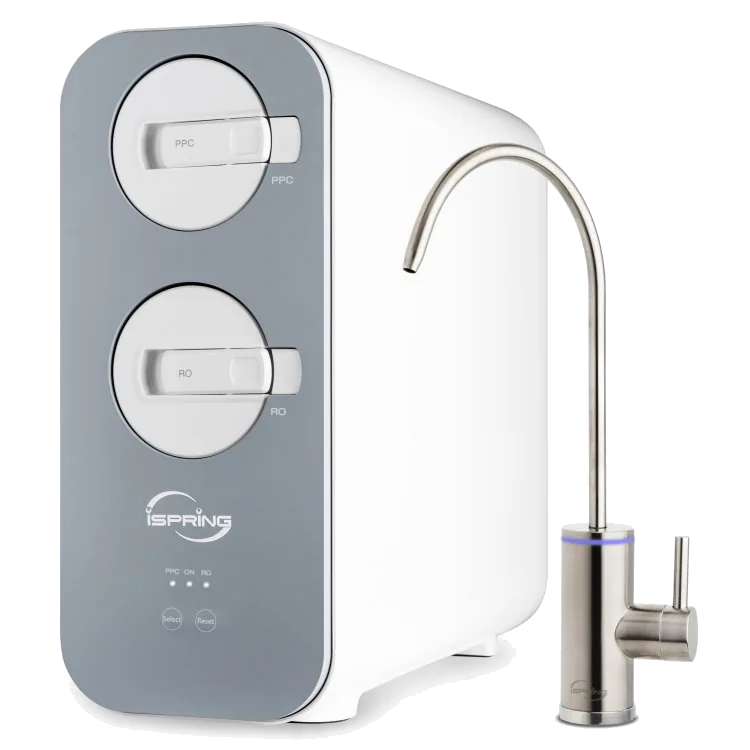
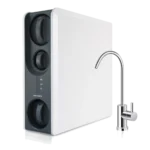
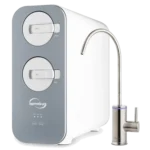
iSpringRO800G 2-Stage Tankless Reverse Osmosis System, 800 GPD
Two-stage tankless reverse osmosis system rated at 800 GPD with a 2.5:1 pure-to-drain ratio, automatic pre-flush and per-filter life indicators.
$528
We may earn a commission if you buy through this link. It never affects our scores. How this works
Usability
Usability
The RO800G is the flow champion of iSpring's consumer line: 800 GPD at 0.6 GPM through only two cartridges, with the best pure-to-drain ratio in the range at 2.5:1. It costs roughly a hundred dollars less than the 500 GPD RO500 while producing 60 percent more water. The catch is certification: iSpring publishes no NSF/ANSI listing for this model, so unlike the RCC7 line its contaminant numbers are manufacturer specifications rather than certified reductions. Two cartridges is also the simplest maintenance schedule iSpring sells, against the five a commercial unit needs, and the membrane is rated at 24 to 36 months. The single expensive item is that membrane at $149.99, which is the priciest cartridge in the consumer range and the reason the running cost is not as low as the cartridge count suggests. Owner discussion of this model is about installation clearance and drain routing rather than performance, which is the profile of a system that works and is awkward to fit.
- 800 GPD at 0.6 GPM, the fastest flow in iSpring's consumer tankless range
- 2.5:1 pure-to-drain ratio, the most water-efficient in the line
- Only two cartridges to track, the simplest maintenance schedule in the range
- Membrane lasts 24 to 36 months, longer than most tanked systems
- Automatic pre-flush protects the membrane after idle periods
- Per-stage indicator lights warn before a filter expires rather than after
- Cheaper than the 500 GPD RO500 despite higher output
- No published NSF/ANSI certification listing; reductions are manufacturer specifications
- Requires an under-sink electrical outlet to run the booster pump
- No remineralization stage, so water tastes flat compared with the alkaline models
- MRO800 membrane costs $149.99 to replace, the priciest single cartridge in the consumer line
- Municipal water only; well water needs pre-treatment first
- Warranty is 1 year and requires product registration to activate
The iSpring RO800G is a two-stage tankless reverse osmosis system rated at 800 gallons per day, the highest-output unit in iSpring's consumer tankless range. Water passes through a PP+CTO composite sediment and carbon block filter (FPPC) and then an 800 GPD reverse osmosis membrane (MRO800) rated to 0.0001 micron, fed on demand by an internal booster pump with no storage tank.
Output runs to 0.6 gallons per minute, filling an 8 oz cup in about 6.5 seconds, at a 2.5:1 pure-to-drain ratio. The system plugs in and self-manages: an automatic pre-flush runs the membrane after idle periods, and per-stage indicator lights blink white below 10 percent filter life and turn red when replacement is due. A manual 30-second flush runs by holding the Select button.
Two cartridges is the fewest in the line, which keeps maintenance simple: the composite filter is replaced every 6 to 12 months and the membrane every 24 to 36 months. iSpring publishes no NSF/ANSI certification listing for the RO800G, so its contaminant figures are manufacturer specifications. It requires electricity and is intended for municipal tap water.
Additional information
Specification: iSpring RO800G 2-Stage Tankless Reverse Osmosis System, 800 GPD
| Water Filtration Specifications | ||||||||||
|---|---|---|---|---|---|---|---|---|---|---|
|
||||||||||
| General Specifications | ||||||||||
|
||||||||||





Questions answered from our data
 How long do iSpring filters last?Of the 24 iSpring systems we list, 24 state a filter life; the most common is 6-12 months (22).
 How much does a reverse osmosis system cost?The 69 reverse osmosis systems we list run from $165 to $3,779, with a median of $367.
 How long do reverse osmosis filters last?Of the 69 reverse osmosis systems we list, 64 state a filter life; the most common is 6-12 months (62).
 Does reverse osmosis remove fluoride?63 of the 76 reverse osmosis systems we list claim to reduce fluoride.