
Product comparison · Reverse Osmosis
APEC ROES‑PH75 vs iSpring RCC7AK‑UV
The APEC ROES-PH75 scores 7.3 and ranks 3rd of 69 in Reverse Osmosis; the iSpring RCC7AK-UV scores 5.9 and ranks 38th of 69 in Reverse Osmosis. The ROES-PH75 leads on certification coverage, the RCC7AK-UV on ease of installation.
 All 22 APEC Water Systems products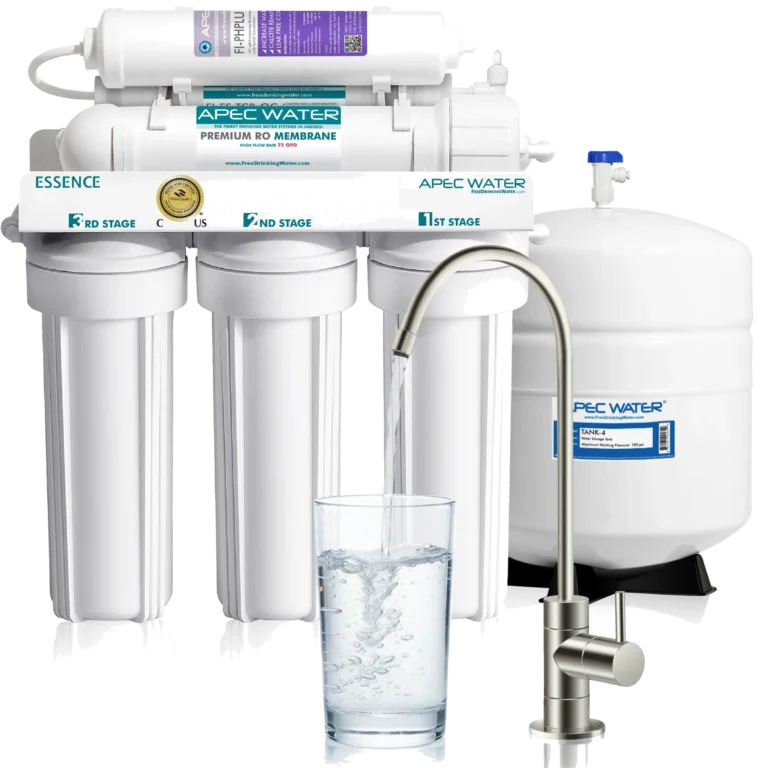
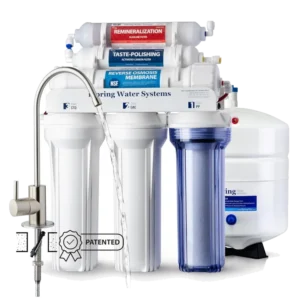
APEC ROES‑PH75
$269 · 3rd of 69 in Reverse Osmosis
- Certification Coverage — 7 against 5
7.3

5.9
All 24 iSpring products 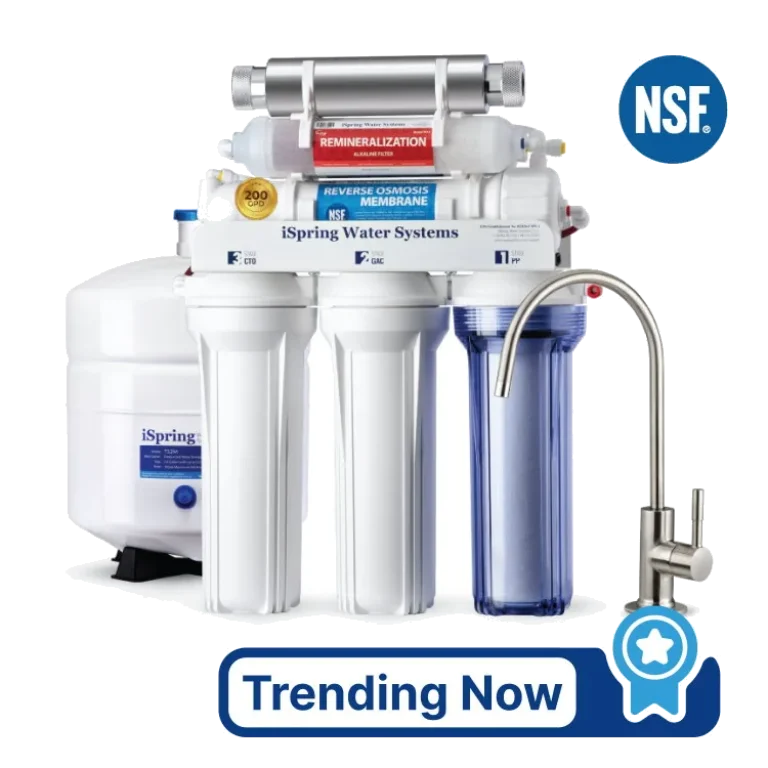
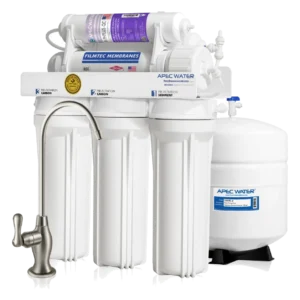
iSpring RCC7AK‑UV
$357 · 38th of 69 in Reverse Osmosis
- Ease of Installation — 7 against 5
Across everything we scored, APEC ROES-PH75 sits 1.43 ahead — led by certification coverage.
Verdict
ROES-PH75 ahead · +1.43 (7.3 vs 5.9)Pick the APEC ROES-PH75 when
Warranty & support matters3vs1
Value matters7vs5
Certification coverage matters7vs5
Pick the iSpring RCC7AK-UV when
Ease of installation matters7vs5
You want UV
Where the APEC ROES‑PH75 and iSpring RCC7AK‑UV differ
Scores on a 0–10 scale. Each row is one criterion, biggest difference first.
Value
+2 APECWarranty & Support
+2 APECAPEC ROES-PH75: 2 Years · iSpring RCC7AK-UV: 1 Year.
Build Quality
+1 APECEase of Installation
+2 iSpringContaminant Reduction
tiedFlow Rate
tiedFilter Life
tiedWhat APEC ROES‑PH75 and iSpring RCC7AK‑UV owners report
Independent sources, scored for each model. ROES-PH75 on 5 of five, RCC7AK-UV on 5.
The iSpring RCC7AK-UV reading covers its product line.
What they say
APEC ROES‑PH75
- An owner in r/water installed this system and submitted the treated water to an independent laboratory rather than reporting an impression, which is the strongest single owner report on any APEC product.
- Elsewhere the alkaline Essence models sit inside the wider ROES-50 and ROES-100 threads: satisfied on taste and output, critical on water use.
iSpring RCC7AK‑UV
- The UV build is not discussed by model and the subreddit's interest in ultraviolet stages is general rather than about this system.
- The RCC7 chassis beneath it is well covered, with an owner lab report showing arsenic to non-detect below 2 ppb set against a recurring leak cluster at faucet handles and housing joints after cartridge changes.
- Threads on low flow through this platform resolve to tank pressure below specification rather than to the membrane, which is worth knowing before a UV stage gets blamed for anything.
The iSpring RCC7AK-UV reading covers its product line.
What they say
APEC ROES‑PH75
- Water Filter Guru's data-driven review scores this system 8.87 overall, with 9.28 for contaminant reduction, 9.70 for design and 8.35 for the company, and states plainly that it is certified for one of the 51 contaminants its product page claims to reduce.
- The same review measures 42.74 GPD against a 75 GPD nameplate at 48 psi and 60.4 degrees Fahrenheit, and a recovery rate of one to 10.6 against APEC's published one to three, calling it the least efficient reverse osmosis system they have tested.
- It ranks eighth of eight in their best-of list.
iSpring RCC7AK‑UV
- Independent coverage of the RCC7 chassis disagrees with itself and the disagreement is the finding.
- TechGearLab lab-tested the alkaline build at 91 out of 100 and ranked it third of thirteen, measuring 100 percent removal of lead, arsenic, uranium and lithium.
- WaterFilterGuru scored the base chassis 6.64 overall with contaminant reduction at 5.25, measured production at roughly 35 gallons a day against a 75 GPD rating, and recorded vanadium and arsenic appearing in the filtered water.
- RO-System.org has withdrawn its recommendation of the base model outright, on the grounds that similar money now buys a more efficient system with a better warranty.
- This model is not separately covered by any of the three.
YouTube
+3 APECThe iSpring RCC7AK-UV reading covers its product line.
What they say
APEC ROES‑PH75
- level and the best independent evidence on any APEC system.
- The tester installed the unit, measured filtration rate, efficiency, recovery and TDS creep, ran a booster pump comparison and sent samples to a certified laboratory.
- Everything above the health guideline was eliminated and pH rose from 7.59 to 8.77, but the laboratory also found manganese 40 percent higher after filtration than before, attributed to the remineralisation media.
- The review states it is not sponsored.
iSpring RCC7AK‑UV
- BOS Water lab-tested the alkaline build of this chassis, which shares this system's core stages, and published the reports; it sells that build under an exclusive discount code.
- Reduction was strong across most contaminants; the same lab work found boron rising from 0.005 to 0.17 ppm in the filtered water, vanadium at 0.02 ppm where none was present in the feed, and trace aluminium, all below the strictest guidelines cited and none of it in the manufacturer's account.
- A second video from the same channel ran that build against the APEC ROES-50 across installation, daily use and lab results and scored the iSpring 3.94 out of 5.
- No independent channel has tested this model specifically.
Amazon
+1 APECThe APEC ROES-PH75 reading covers its product line; the iSpring RCC7AK-UV reading covers its product line.
What they say
APEC ROES‑PH75
- The ROES-PH75 listing reads 4.4 stars, but its count of roughly 14,600 spans a variation family covering the whole Essence tank range rather than this configuration alone, so it is recorded at line scope.
- The separate ROES-PH75X listing holds 4.6 across 369 ratings of its own.
- Amazon's brand panel renders in two forms across APEC's listings: a proportion line reading 91 percent of ratings for the brand at 4-plus stars over 50,000-plus orders in the trailing three months, and a badge form carrying Highly Rated, Trending and Low Returns with no denominator.
- The proportion form is the scoreable one and is what carries here.
iSpring RCC7AK‑UV
- This model's Amazon listing exists and publishes no rating in readable form, so the figure below is the chassis rather than the product.
- The pumpless alkaline build of the same platform holds 4.6 out of 5 across 21,461 ratings with 2,000-plus units sold in the past month, and the colour variants of that build share one review file.
- Amazon's brand panel puts 91 percent of iSpring ratings at four stars or better over 100,000-plus orders in the trailing three months.
Owner reviews
+3 APECThe APEC ROES-PH75 reading covers its product line; the iSpring RCC7AK-UV reading covers the whole brand.
What they say
APEC ROES‑PH75
- Lowe's carries a review file on this model, with leaks among the complaints, and Home Depot carries another whose bodies run across the Essence range.
- The line's readable retailer figure is the ROES-50 at 4.8 across 218 Walmart reviews.
- Trustpilot's brand profile is 4.1 from 658 reviews.
iSpring RCC7AK‑UV
- No retailer publishes a readable pool against the UV build, and the files that exist for it return no star average or recommend rate of their own.
- Falling back to the brand's Home Depot record, where the figures that do return are 98 percent recommend on the pumped RCC7 across 120 reviews and 93 percent on the review file Home Depot shares across the whole tankless range.
- Those files carry iSpring's own attribution line against individual reviews, so they are mixed pools and the recommend rate is the only figure in them worth reading.
APEC ROES‑PH75 vs iSpring RCC7AK‑UV: pros and cons
What each one does well, and where it falls short.
Pros 5
Scored 8.87 overall in independent lab-backed testing with no sponsorship
WQA Gold Seal certification to NSF/ANSI 58
Six stages including calcium carbonate remineralisation
75 GPD nameplate suits a household of four without a tank wait
Annual filter cost stays close to the cheaper Essence models
Cons 5
Measured at 42 GPD in independent real-world testing against a 75 GPD rating
Certified scope is total dissolved solids reduction only
Filter changes need the system unhooked and removed to open the housings
Warranty is one year unless registered within eight weeks
Return shipping cost is the weak point of the returns policy
Pros 6
NSF/ANSI 58 certified as a complete system rather than by component, for TDS reduction at 97.9%
Transparent first-stage housing allows filter inspection without opening it
11-watt UV stage with a flow sensor that runs the lamp only when water moves
Widest feed tolerances in the line at pH 3.0 to 11.0 and up to 750 ppm TDS
Alkaline stage raises pH by roughly 0.5 to 0.8 depending on source water
Backed by a 1-year money-back guarantee alongside the warranty
Cons 9
NSF certification covers TDS reduction only, not the lead figure iSpring publishes
Highest running cost in the RCC7 line at roughly $112 a year including the UV bulb
Marketed for well water and untreated sources, but iSpring's own FAQ advises against relying on RO for microorganisms
iSpring publishes the waste ratio as both 1:3 and up to 1:2 on the same page
Requires a power outlet for the UV transformer, unlike the pumpless RCC7 and RCC7AK
An inch taller than the RCC7, so under-sink clearance needs checking
Warranty is 1 year and requires product registration to activate
Push-to-connect fittings leak on initial installation for a minority of buyers
Not designed to disinfect water or treat microorganisms
APEC ROES‑PH75 vs iSpring RCC7AK‑UV: the numbers
Price, scores and rank, then only the specs that differ. Green marks the side with more.
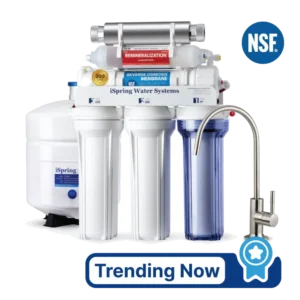
5.9
38th of 69 in Reverse Osmosis
Filtration
Both Alkaline Remineralization, Carbon Block, Granular Activated Carbon, Reverse Osmosis, Sediment
APEC ROES‑PH75
Nothing more
iSpring RCC7AK‑UV
+ UV
Removes
Both Arsenic, Chlorine, Chromium, Fluoride, PFAS, TDS, Lead
APEC ROES‑PH75
+ Heavy metals, Nitrate, Taste and Odor, Cysts, VOCs
iSpring RCC7AK‑UVMore
+ Barium, Cadmium, Copper, PCBs, Selenium, Asbestos, Mercury
SpecAPEC ROES‑PH75iSpring RCC7AK‑UV
Warranty2 Years1 Year
DimensionsNot listed15.50" x 5.10" x 19.00"
WeightNot listed28 lb
Made inUSATaiwan
Same on both
- Certifications NSF/ANSI 58
- Flow rate Under 100 GPD
- Filter life 6-12 months
- Connection Point of use fitting
- Housing BPA-Free Plastic
We earn a commission if you buy through these links. It never changes a score.
Not sold on either one?
The top-scored and the cheapest other pick from each brand.
More from APEC Water Systems 13 scored in Reverse Osmosis
What’s different
- Filtration: no Alkaline Remineralization
- Removes: adds Microplastics
Pick it ifValue matters9vs7
More from iSpring 23 scored in Reverse Osmosis
What’s different
- Filtration: no UV
Pick it ifValue matters7vs5
What’s different
- Filtration: no Alkaline Remineralization, UV
Pick it ifValue matters7vs5
APEC ROES‑PH75 vs iSpring RCC7AK‑UV: common questions
Is the APEC ROES-PH75 better than the iSpring RCC7AK-UV?
On our scores, the APEC ROES-PH75 is ahead, 7.3 against 5.9. The APEC ROES-PH75 leads on certification coverage (7 against 5), value (7 against 5), warranty & support (3 against 1) and build quality (8 against 7). The iSpring RCC7AK-UV leads on ease of installation (7 against 5).
Which is cheaper, the APEC ROES-PH75 or the iSpring RCC7AK-UV?
The APEC ROES-PH75, at $269 against $357: $88 less.
Which removes more contaminants, the APEC ROES-PH75 or the iSpring RCC7AK-UV?
The APEC ROES-PH75 lists 12 and the iSpring RCC7AK-UV lists 14, with 7 on both lists. Only the iSpring RCC7AK-UV lists Barium, Cadmium, Copper, PCBs, Selenium, Asbestos and Mercury.
Which has the longer warranty, the APEC ROES-PH75 or the iSpring RCC7AK-UV?
The APEC ROES-PH75: 2 Years, against 1 Year.
What do owners say about the APEC ROES-PH75 and the iSpring RCC7AK-UV?
Across 5 independent sources scored for both, the APEC ROES-PH75 is ahead on Google, YouTube, Amazon and Owner reviews; Reddit is level.
More reverse osmosis comparisons
More head-to-heads with these two, plus the full brand comparison.
Scores calculated 17 September 2026 · Products excluded where fewer than two independent sources cover them · How we score