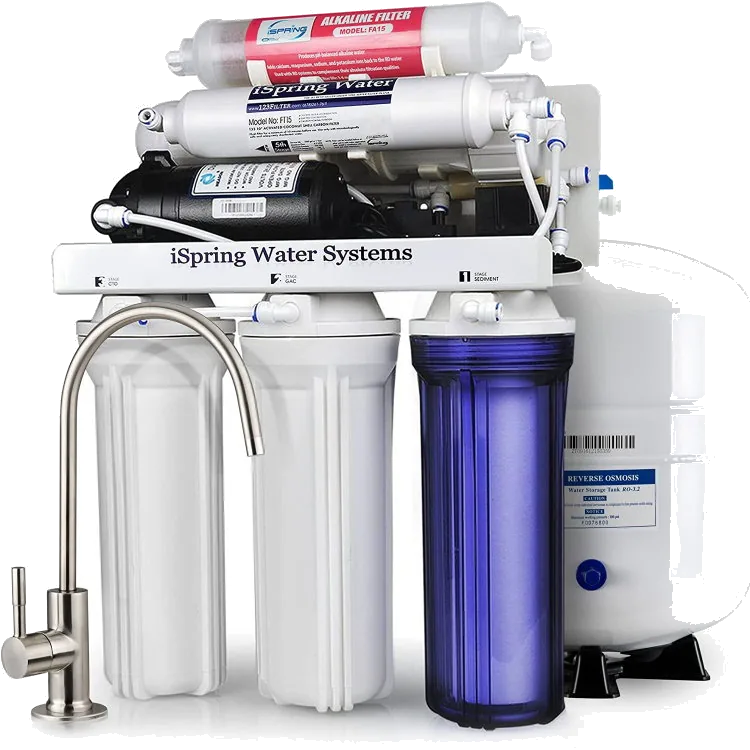
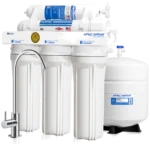
iSpringRCC7P-AK 6-Stage Alkaline Reverse Osmosis System with Booster Pump, 75 GPD
Six-stage alkaline reverse osmosis system with booster pump, reaching up to 1.5:1 pure-to-waste at 75 GPD.
$378
We may earn a commission if you buy through this link. It never affects our scores. How this works
Usability
Usability
Adding a booster pump takes the RCC7 platform from wasting three gallons per gallon produced to producing roughly 1.5 gallons per gallon wasted, which is the single biggest functional upgrade in the line. It costs $136 more than the RCC7AK and needs a power outlet, but on low-pressure supply it is the difference between a system that works and one that trickles. The cost of the pump is not only the price: this model is absent from NSF's listing for the company, where the pumpless RCC7AK it is built on is listed for TDS reduction. So the pumped system is the better machine and the worse-evidenced one, and the published contaminant figures on this row are manufacturer specifications throughout. It is also assembled in China where the pumpless RCC7 systems are made in Taiwan, which is worth knowing rather than worth worrying about. The alkaline stage is the same one the RCC7AK carries, and at fourteen dollars over the non-alkaline RCC7P it is hard to argue against taking it.
- Transparent first-stage housing allows filter inspection without opening it
- Booster pump reaches up to 1.5:1 pure-to-waste, roughly four times better than the unpumped models
- Works on supply pressure below 40 psi where pumpless systems struggle
- Alkaline stage returns calcium and magnesium for a less flat taste
- Costs $136 more than the RCC7AK for the same filtration stages
- Not listed in NSF's certification database, unlike the pumpless RCC7AK it is built on
- Requires a 100-240V outlet under the sink
- 31.2 lb, over six pounds heavier than the pumpless models
- Manufactured in China rather than Taiwan like the pumpless RCC7 systems
- Warranty is 1 year and requires product registration to activate
- Push-to-connect fittings leak on initial installation for a minority of buyers
- Not designed to disinfect water or treat microorganisms
The iSpring RCC7P-AK is the six-stage alkaline RCC7AK with an electric booster pump added. The pump raises membrane feed pressure to its ideal range, which improves both production speed and drain ratio, and makes the system viable in homes where supply pressure falls below 40 psi.
That pump changes the efficiency picture substantially: the RCC7P-AK reaches up to 1.5 gallons of filtered water per gallon sent to drain, against roughly 1 to 3 on the unpumped RCC7 and RCC7AK. Production stays at 75 gallons per day. The pumped builds do not appear in NSF's listing for iSpring, so unlike the pumpless RCC7 and RCC7AK this model carries no certification of its own.
The pump requires a 100 to 240V outlet under the sink and adds six pounds to the system. Unlike the pumpless models, which are built in Taiwan, pump-equipped iSpring systems are manufactured in China.
Additional information
Specification: iSpring RCC7P-AK 6-Stage Alkaline Reverse Osmosis System with Booster Pump, 75 GPD
| Water Filtration Specifications | ||||||||||||||
|---|---|---|---|---|---|---|---|---|---|---|---|---|---|---|
|
||||||||||||||
| General Specifications | ||||||||||||||
|
||||||||||||||
Compared in




Questions answered from our data
 How long do iSpring filters last?Of the 24 iSpring systems we list, 24 state a filter life; the most common is 6-12 months (22).
 How much does a reverse osmosis system cost?The 69 reverse osmosis systems we list run from $165 to $3,779, with a median of $367.
 How long do reverse osmosis filters last?Of the 69 reverse osmosis systems we list, 64 state a filter life; the most common is 6-12 months (62).
 Does reverse osmosis remove fluoride?63 of the 76 reverse osmosis systems we list claim to reduce fluoride.