
Product comparison · Reverse Osmosis
APEC ROES‑50 vs iSpring RCC7
The APEC ROES-50 scores 7.3 and ranks 4th of 69 in Reverse Osmosis; the iSpring RCC7 scores 6.3 and ranks 17th of 69 in Reverse Osmosis. The ROES-50 leads on certification coverage, the RCC7 on ease of installation.
 All 22 APEC Water Systems products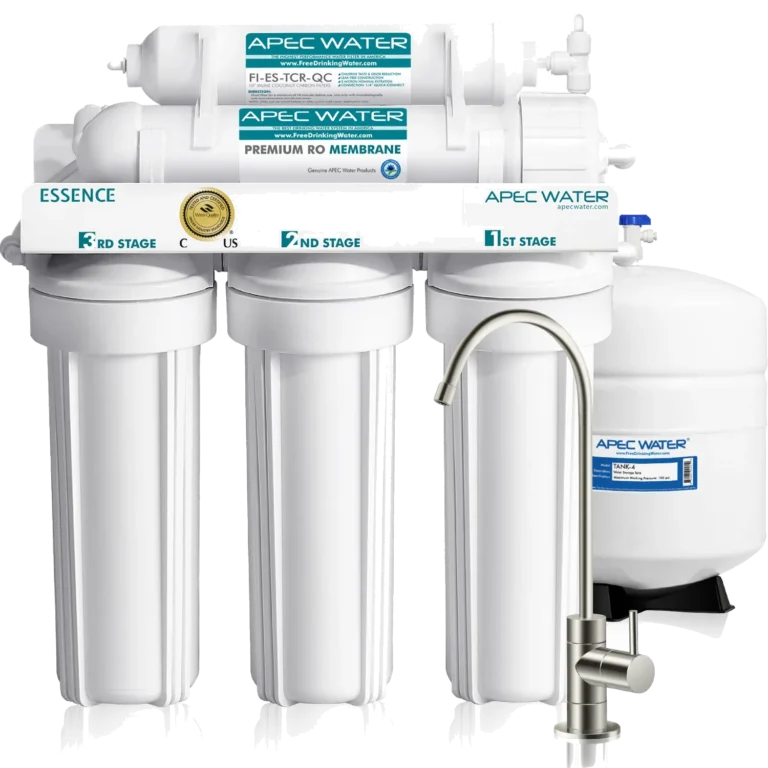
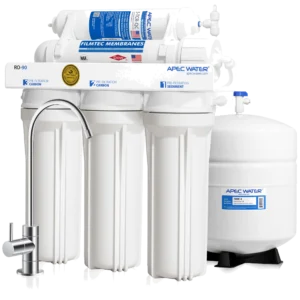
APEC ROES‑50
$231 · 4th of 69 in Reverse Osmosis
- Certification Coverage — 7 against 5
7.3

6.3
All 24 iSpring products 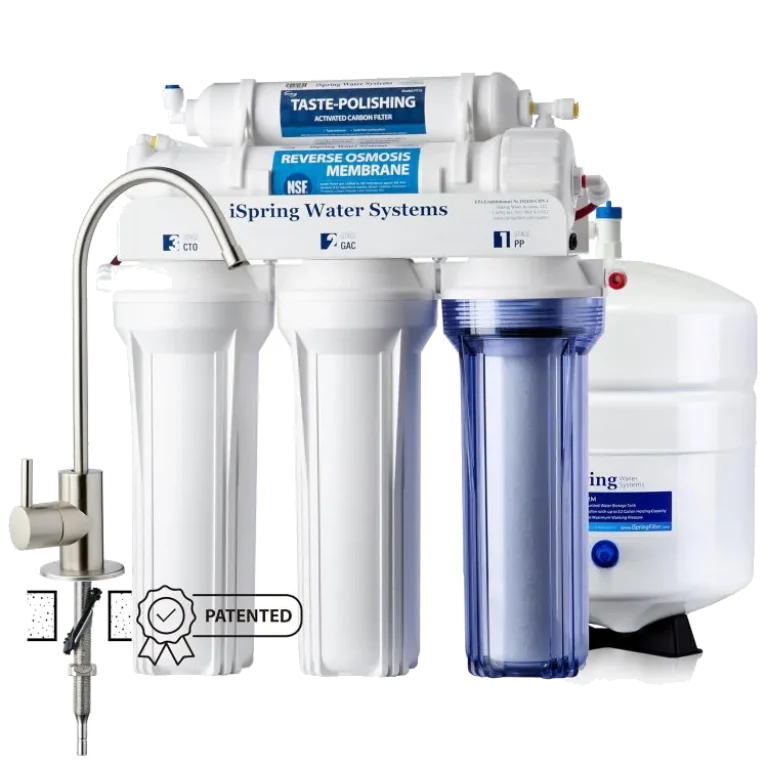
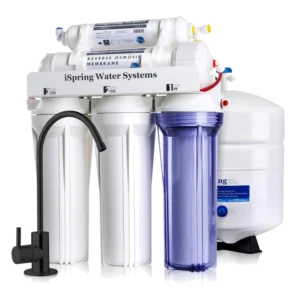
iSpring RCC7
$231 · 17th of 69 in Reverse Osmosis
- Ease of Installation — 8 against 5
Across everything we scored, APEC ROES-50 sits 1.06 ahead — led by certification coverage.
Verdict
ROES-50 ahead · +1.06 (7.3 vs 6.3)Pick the APEC ROES-50 when
Warranty & support matters3vs1
Value matters9vs7
Certification coverage matters7vs5
Pick the iSpring RCC7 when
Ease of installation matters8vs5
Where the APEC ROES‑50 and iSpring RCC7 differ
Scores on a 0–10 scale. Each row is one criterion, biggest difference first.
Value
+2 APECWarranty & Support
+2 APECAPEC ROES-50: 2 Years · iSpring RCC7: 1 Year.
Ease of Installation
+3 iSpringContaminant Reduction
tiedFlow Rate
tiedFilter Life
tiedBuild Quality
tiedWhat APEC ROES‑50 and iSpring RCC7 owners report
Independent sources, scored for each model. ROES-50 on 5 of five, RCC7 on 5.
The iSpring RCC7 reading covers its product line.
What they say
APEC ROES‑50
- Owner reports split sharply.
- Long-term satisfaction is real, including a multi-year r/Homebrewing account of hard well water handled without incident, and the ROES-50 is the default recommendation in most under-sink threads.
- Against that sits the largest cluster of hardware complaints APEC has: a run of separate threads on leaks at the housings and fittings, one owner reporting the taste degrading after about sixty gallons, and a poster who could not get a replacement and would not buy the brand again.
iSpring RCC7
- r/WaterTreatment carries a substantial iSpring pool on this chassis and it splits cleanly.
- On performance, an owner posted lab results showing arsenic reduced to non-detect below 2 ppb, and an installer in r/kitchenremodel names the chassis as one of two systems worth recommending out of everything they have fitted.
- On reliability, a distinct leak cluster runs through the same subreddit: faucet handles weeping at six months, housing joints leaking after a cartridge change, and low-flow complaints that resolve to storage tank pressure sitting at 5.5 psi against the 7 psi specification.
- Separately, two owners on one thread report the pressurised storage tank failing early, one of them alongside a rubber taste in new water.
Both readings are about these exact models.
What they say
APEC ROES‑50
- TechGearLab ranked the ROES-50 first of thirteen filters with an overall score of 96 and an Editors' Choice award, scoring 10.0 on forever chemicals and microplastics, 9.8 on lead and metals, 9.3 on fluoride and nitrates and 8.8 on taste and chlorine, at roughly 75 dollars a year to run.
- Written coverage is consistent on the gap that ranking sits inside: the WQA listing covers total dissolved solids while the product page names more than fifty contaminants.
iSpring RCC7
- Independent laboratory work on the RCC7 exists and it is the most detailed testing any iSpring product has: WaterFilterGuru measured TDS down from 875 to 45 ppm and fluoride from 2.4 to 0.3 ppm, and also measured vanadium rising from 0.0017 to 0.111 ppm and arsenic appearing at 0.00333 ppm where none had been detected before filtration.
- The same test clocked production at roughly 35 gallons a day against the 75 GPD rating and called it one of the slowest under-sink systems it had measured.
- TechGearLab, testing the alkaline build of the same chassis, scored it 91 out of 100 and ranked it third of thirteen.
- RO-System.org has withdrawn its recommendation of this model outright, stating that the same money now buys a more efficient system with a better warranty.
YouTube
+2 APECThe iSpring RCC7 reading covers its product line.
What they say
APEC ROES‑50
- Independent lab testing scores this system 4.42 out of 5 for filtration with no chemical leaching detected, 4.5 for usability and 4.99 for cost, for 4.55 out of 5 overall and a first place among budget under-sink systems.
- The same tester's feed water valve leaked and could not be fixed, and reports cracked housings as a recurring theme in the platform reviews.
- A separate head-to-head against the iSpring RCC7K puts the APEC ahead at 4.55 to 3.94, on filtration rather than features.
iSpring RCC7
- BOS Water lab-tested the alkaline build of this chassis, which shares this system's core stages, and published the reports; it sells that build under an exclusive discount code.
- Reduction was strong across most contaminants; the same lab work found boron rising from 0.005 to 0.17 ppm in the filtered water, vanadium at 0.02 ppm where none was present in the feed, and trace aluminium, all below the strictest guidelines cited and none of it in the manufacturer's account.
- A second video from the same channel ran that build against the APEC ROES-50 across installation, daily use and lab results and scored the iSpring 3.94 out of 5.
- No independent channel has tested this model specifically.
Amazon
+2 APECThe iSpring RCC7 reading covers its product line.
What they say
APEC ROES‑50
- The ROES-50 holds 4.4 stars across more than 9,000 Amazon ratings, the largest pool in the brand, distributed 77 percent five-star against 8 percent one-star.
- Amazon flags the listing as a frequently returned item, which sits oddly against that average and is worth weighing alongside it.
- Amazon's brand panel renders in two forms across APEC's listings: a proportion line reading 91 percent of ratings for the brand at 4-plus stars over 50,000-plus orders in the trailing three months, and a badge form carrying Highly Rated, Trending and Low Returns with no denominator.
- The proportion form is the scoreable one and is what carries here.
iSpring RCC7
- The base RCC7 listing is currently unavailable on Amazon and carries no rating at all; the brushed-nickel build is the live listing and publishes no readable figure.
- Falling back within the chassis, the alkaline RCC7AK holds 4.6 out of 5 across 21,461 ratings with 2,000-plus units sold in the past month, which is the deepest pool on any tanked system in this comparison and describes the same platform with one extra stage.
- Amazon's brand panel puts 91 percent of iSpring ratings at four stars or better over 100,000-plus orders in the trailing three months.
Owner reviews
+2 APECThe iSpring RCC7 reading covers its product line.
What they say
APEC ROES‑50
- Walmart reads 4.8 across 218 reviews with 89 percent at five stars and 8 percent at four.
- Home Depot and Lowe's both carry their own review files, and two things temper the headline: Lowe's discloses that its summary includes incentivised reviews, and Home Depot's file carries a repeated failure that the star average does not show, hairline cracks forming in the filter housing caps and flooding the cabinet, described by more than one owner as a known pattern rather than a one-off.
- Trustpilot's brand profile is 4.1 from 658 reviews.
iSpring RCC7
- Walmart lists the RCC7 at 4.8 out of 5 under a product-rating heading rather than a seller one, and one of the review bodies on that file also appears word for word on Lowe's listing for the same model, which means the two retailers are surfacing one shared review file rather than two pools.
- Home Depot carries the deepest file on this model and its iSpring review pages attach the brand's own attribution line to individual reviews, so that pool is mixed and its star average cannot be separated from the brand's contribution to it.
- The figure is recorded at the line and scored a band below what an independently collected big-box pool would earn.
- Across the Home Depot listings that return their own figures, recommend rates run 98 percent on the pumped RCC7 and 93 percent on the pooled tankless file.
APEC ROES‑50 vs iSpring RCC7: pros and cons
What each one does well, and where it falls short.
Pros 5
Ranked first of thirteen filters by TechGearLab in July 2026 with a 96 overall score
Complete lab removal of lead, arsenic, uranium and lithium in independent testing
WQA Gold Seal certification to NSF/ANSI 58
Annual running cost around 75 dollars, among the lowest for a tank RO
Published dimensions and weight, which APEC does not give for most of its range
Cons 5
Certified scope is total dissolved solids reduction, not the fifty-two contaminants listed
Roughly three gallons to drain per gallon produced
Leaking feed water valves are the most common complaint in independent review and Amazon feedback
Warranty is one year unless registered within eight weeks
Filter changes require unscrewing three housings rather than twisting cartridges
Pros 5
NSF/ANSI 58 certified as a complete system rather than by component, for TDS reduction at 97.9%
Transparent first-stage housing allows filter inspection without opening it
Operates with no electricity required
Replacement filters run roughly $49 to $75 per year
3.2-gallon storage tank supports family-scale demand
Cons 7
NSF certification covers TDS reduction only, not the lead and fluoride figures iSpring publishes
Sends roughly 3 gallons to drain for every gallon produced, the worst ratio in the RCC7 line
Rated for municipal water only; well water requires point-of-entry pre-treatment
Flow drops noticeably when the storage tank is fully drained
Warranty is 1 year and requires product registration to activate
Push-to-connect fittings leak on initial installation for a minority of buyers
Not designed to disinfect water or treat microorganisms
APEC ROES‑50 vs iSpring RCC7: the numbers
Price, scores and rank, then only the specs that differ. Green marks the side with more.
7.3
4th of 69 in Reverse Osmosis
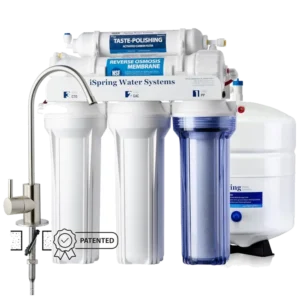
6.3
17th of 69 in Reverse Osmosis
Removes
Both Arsenic, Chlorine, Chromium, Fluoride, PFAS, TDS, Lead
APEC ROES‑50
+ Heavy metals, Nitrate, Taste and Odor, Cysts, Microplastics, VOCs
iSpring RCC7More
+ Barium, Cadmium, Copper, PCBs, Selenium, Asbestos, Mercury
SpecAPEC ROES‑50iSpring RCC7
Warranty2 Years1 Year
Dimensions16 x 5.25 x 17.5 in15.50" x 5.10" x 18.00"
Weight26 lb25 lb
Made inUSATaiwan
Same on both
- Filtration Carbon Block, Granular Activated Carbon, Reverse Osmosis, Sediment
- Certifications NSF/ANSI 58
- Flow rate Under 100 GPD
- Filter life 6-12 months
- Connection Point of use fitting
- Housing BPA-Free Plastic
We earn a commission if you buy through these links. It never changes a score.
Not sold on either one?
The top-scored and the cheapest other pick from each brand.
More from APEC Water Systems 13 scored in Reverse Osmosis
What’s different
- Filtration: adds Alkaline Remineralization
- Removes: no Microplastics
Pick it ifBuild quality matters8vs7
What’s different
- Certifications: none listed
- Removes: no Heavy metals, Microplastics
More from iSpring 23 scored in Reverse Osmosis
What’s different
- Filtration: adds Alkaline Remineralization
Pick it ifYou want alkaline remineralization
APEC ROES‑50 vs iSpring RCC7: common questions
Is the APEC ROES-50 better than the iSpring RCC7?
On our scores, the APEC ROES-50 is ahead, 7.3 against 6.3. The APEC ROES-50 leads on certification coverage (7 against 5), value (9 against 7) and warranty & support (3 against 1). The iSpring RCC7 leads on ease of installation (8 against 5).
Which removes more contaminants, the APEC ROES-50 or the iSpring RCC7?
The APEC ROES-50 lists 13 and the iSpring RCC7 lists 14, with 7 on both lists. Only the iSpring RCC7 lists Barium, Cadmium, Copper, PCBs, Selenium, Asbestos and Mercury.
Which has the longer warranty, the APEC ROES-50 or the iSpring RCC7?
The APEC ROES-50: 2 Years, against 1 Year.
What do owners say about the APEC ROES-50 and the iSpring RCC7?
Across 5 independent sources scored for both, the APEC ROES-50 is ahead on Google, YouTube, Amazon and Owner reviews; the iSpring RCC7 is ahead on Reddit.
More reverse osmosis comparisons
More head-to-heads with these two, plus the full brand comparison.
Scores calculated 16 September 2026 · Products excluded where fewer than two independent sources cover them · How we score